
Why Am I Losing So Much Hair? What Your Body May Be Trying to Tell You

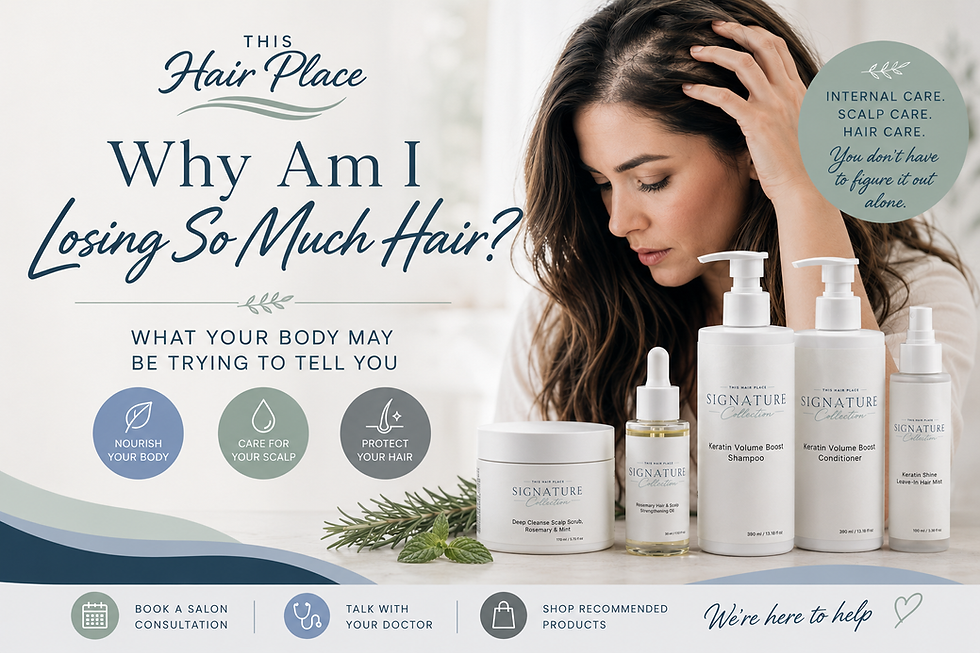
Why am I losing hair?
Have you noticed more hair in your brush? More in the shower? Maybe your ponytail feels smaller than it used to, or you're beginning to see more scalp when you style your hair.
If you're wondering, “Why am I suddenly losing so much hair?” you're definitely not the only person asking.
Hair thinning and excessive shedding have always been conversations I have behind the chair, but lately I'm hearing about them even more. Some of my clients have experienced significant weight loss or are taking GLP-1 weight-loss medications. For others, there doesn't seem to be an obvious explanation. And that's why I think we need to talk about it.
Because sometimes hair loss isn't just a hair problem.
Your hair may be giving you a reason to look a little more closely at what's been happening with your body.

Hair Loss or Hair Shedding?
First, there's a difference between losing hair and experiencing excessive shedding.
We all shed hair. The American Academy of Dermatology says it's normal to shed approximately 50 to 100 hairs a day.
Sometimes, however, something disrupts the normal hair-growth cycle and many more hairs than usual enter the shedding phase.
One common form of excessive shedding is called telogen effluvium.
It can happen after the body experiences a significant stress or change—such as illness, surgery, major emotional stress or significant weight loss.
Here's what surprises many people:
The shedding may not happen immediately.

It can show up a few months after the triggering event.
That's one reason I encourage clients who suddenly notice more shedding to think back. Don't only ask yourself what changed this week. Think about what was happening a few months ago, too.
What About GLP-1 Weight-Loss Medications?
This has become a particularly important conversation with the increased use of GLP-1 medications.
If you're taking one and experiencing hair thinning or shedding, that doesn't necessarily mean the medication itself is directly attacking your hair follicles.
The American Academy of Dermatology explains that dermatologists believe the sudden weight loss people can experience while taking GLP-1 medications may trigger telogen effluvium. Researchers are still working to understand whether the medications themselves may also have a direct effect on hair growth.
There's another possible piece of the puzzle:
When you're eating less, what you're eating matters even more.
If your appetite has decreased considerably, you may also be consuming less protein, fewer calories, or fewer vitamins and minerals than your body was getting before.
That doesn't mean you should stop a medication prescribed by your healthcare provider because you're worried about your hair. It means hair changes are worth mentioning to your medical team.
Are You Getting Enough Protein?
This is something I frequently discuss with clients experiencing hair changes.

Hair is made primarily of a protein called keratin. That doesn't mean eating huge quantities of protein will magically make your hair grow, but adequate nutrition matters.
If you've significantly reduced the amount of food you're eating, take a look at what you're actually consuming.
Are you getting enough protein?
Are you eating a variety of nutrient-rich foods?
Are you eating enough to meet your nutritional needs?
Instead of immediately reaching for every bottle labeled “hair vitamin,” sometimes the better first step is looking at the bigger nutritional picture.
If you aren't sure whether you're meeting your needs—particularly during significant weight loss—talk with your doctor or a registered dietitian.
Let's Talk About Iron—and Ferritin

Here's another conversation I have behind the chair.
Most people have heard about iron deficiency and anemia.
Fewer people know much about ferritin.
Ferritin is a protein that stores iron, and measuring ferritin can give your healthcare provider information about your body's iron stores.
That's important because “my iron was normal” doesn't necessarily tell us everything about someone's iron status.
Research has found associations between lower ferritin levels and some forms of nonscarring hair loss, and dermatologists may include ferritin when evaluating someone with diffuse shedding. However, the relationship between ferritin and hair loss is complicated, and there isn't one universally accepted ferritin number that guarantees healthy hair growth.
So I don't think the answer is diagnosing yourself based on a number you found online.
Instead, ask the question.
If you're experiencing unexplained or persistent shedding, ask your healthcare provider whether evaluating your iron status—including ferritin—would be appropriate for you.
And please don't start taking iron supplements just because your hair is shedding. Iron isn't a supplement where “more” automatically means “better.” Your healthcare provider can determine whether you actually need it.
What About Biotin?
Biotin seems to be everywhere in the hair world.
Hair vitamins. Gummies. Shampoos. Supplements.
It's become so associated with healthy hair that it's easy to assume:
Hair is thinning = I need biotin.
It's not quite that simple.
Biotin is an important nutrient, and true biotin deficiency can affect the hair. But taking extra biotin isn't automatically the solution for unexplained thinning or shedding.
There's another reason to be careful with high-dose biotin supplements: biotin can interfere with certain laboratory tests and potentially produce inaccurate results.
That's especially worth remembering if you're trying to figure out why your hair is changing in the first place.
Rather than automatically adding another supplement, I'd rather see you become curious about the cause.
Now Let's Talk About the Scalp
Everything we've discussed so far is happening internally.
But there's another side of the conversation:
How are we taking care of your scalp and the hair you have right now?

A shampoo can't correct an iron deficiency.
A conditioner can't fix inadequate nutrition.
And a scalp treatment can't correct a hormonal or medical condition.
But appropriate hair and scalp care still matters.
For clients experiencing buildup, our This Hair Place Signature Collection Deep Cleanse Scalp Scrub — Rosemary & Mint can help remove buildup and refresh the scalp.
For scalp nourishment, I also like our Rosemary Hair & Scalp Strengthening Oil.
And despite the name, there's much more than rosemary in that bottle.
It's a blend that includes sunflower, castor, sweet almond, argan, hemp, olive and avocado oils, along with rosemary and peppermint oils and nettle extract. It's designed to nourish the scalp while conditioning dry or brittle hair, improving resilience and restoring shine.
Apply it to the scalp and hair, allow it to sit for at least 15 minutes, and then shampoo.
Does Rosemary Oil Grow Hair?
This is where I want to be careful, because there's a lot of information—and marketing—online about rosemary oil.
There has been some interesting research. One small randomized study compared rosemary oil with 2% minoxidil in people with androgenetic alopecia and reported increased hair counts after six months in both groups.
That's interesting.
But one study doesn't make rosemary oil a miracle cure for every kind of hair loss—and the study was looking at a particular type of hair loss, not every reason someone might be shedding.
That's why I prefer to position our Rosemary Hair & Scalp Strengthening Oil as supportive scalp and hair care rather than promise that a bottle of oil will fix hair loss.
We're nourishing the scalp and conditioning the hair while also looking at the bigger picture.
What If Your Thinning Hair Is Also Fragile?
There's another distinction I want you to understand:
Hair shedding and hair breakage aren't the same thing.
Hair that sheds generally comes out from the root as part of the hair-growth cycle. Breakage happens somewhere along the hair shaft.
But you can experience both at the same time.
And if you're already losing density from increased shedding, breakage can make your hair look and feel even thinner.
That's why protecting the hair you still have becomes especially important.
For clients whose fine or thinning hair has also become fragile, I may recommend our Keratin Shampoo, Keratin Conditioner and Keratin Leave-In.
I'm not recommending keratin because it will stop hair loss or make new follicles suddenly produce hair.
I'm recommending it because fragile hair needs care.
A strengthening and conditioning routine can help support the hair, improve manageability and reduce some of the mechanical stress caused by tangling, brushing, heat styling and everyday wear.
The Keratin Leave-In gives us another layer of care and protection between shampoos.
When you're already concerned about thinning, my goal is simple:
We don't want unnecessary breakage making the problem look worse.
There Isn't One Hair-Loss Routine for Everyone
This is probably one of the most important things I want you to take away from this article.
You don't necessarily need a “hair-growth system” just because you're shedding.
One person may need more attention to scalp care.
Another may have a healthy scalp but extremely fragile hair that needs strengthening and protection.
Someone else may benefit from both.
And another person may need me to say:
“I think it's time to talk with your doctor or dermatologist about this.”
That's why I would rather look at your individual hair and scalp than automatically sell everyone experiencing thinning the same three products.
When Should You Talk to Your Doctor?
If you've noticed a significant change—particularly sudden, excessive, patchy or persistent hair loss or shedding—bring it up with your healthcare provider or dermatologist.
And give them some history.
Think back over the previous several months.
Have you experienced significant or rapid weight loss?
Started or changed a medication?
Changed the way you're eating?
Been sick or had surgery?
Experienced an unusually stressful period?
Noticed other changes in your body?
Tell them.
Depending on your individual situation, your healthcare provider can determine whether further evaluation or blood work makes sense.

And Talk to Your Hairstylist, Too
Your hairstylist isn't a replacement for your doctor or dermatologist.
I can't diagnose the cause of your hair loss from behind the chair.
But there is something I can do.
I can notice change.
I see your hair and scalp up close. And if you've been sitting in my chair for years, I also have the advantage of knowing what's normal for your hair.
I may notice that your density feels different.
I may see increased breakage.
I may notice changes in your scalp.
And most importantly, I can listen to what you've been experiencing and help you decide what makes sense from a haircare standpoint.
We can look at your current routine, talk about scalp care and make sure you're treating fragile hair appropriately.
And when something seems like it needs investigation beyond the salon, I'll encourage you to take those questions to your healthcare provider.
Start With Curiosity, Not Panic
Seeing your hair change can be scary.
And when that happens, it's very easy to start buying every supplement, serum, oil and “miracle growth” product that appears in your social media feed.
I'd rather you start somewhere else.
Start with questions.
What has changed in the last few months?
How quickly have you been losing weight?
Are you getting adequate nutrition and protein?
Could your iron stores be worth discussing with your doctor?
Are you experiencing shedding, breakage—or both?
How is your scalp doing?
And what can we do to protect and care for the hair you have while you investigate what's happening internally?
Hair loss can have many causes, and sometimes finding the answer takes more than one person.
Your healthcare provider or dermatologist can investigate what's happening inside.
I can help you care for your scalp and hair on the outside.
And together, those conversations can help you make thoughtful decisions rather than simply reaching for the next miracle product.
If you're concerned about thinning, shedding or fragile hair, book an appointment at This Hair Place and let's take a look at what's happening. We can help you determine an appropriate at-home hair and scalp routine, including products from the This Hair Place Signature Collection when they're right for you.
And if you're already noticing changes, don't be afraid to bring them up at your next appointment.
Sometimes the most helpful thing I can do isn't sell you another bottle.
It's help you ask better questions.
This article is for educational purposes and isn't intended to diagnose or treat hair loss or replace advice from your physician, dermatologist or other qualified healthcare professional.
Sources & Further Reading
Want to learn more? These trusted medical and research resources provide additional information on hair shedding, nutrition, iron stores, biotin and rosemary oil.
American Academy of Dermatology — Hair Loss and GLP-1 MedicationsInformation about potential hair and skin changes associated with GLP-1 medications, including how rapid weight loss and reduced intake of protein and other nutrients may contribute to excessive hair shedding.https://www.aad.org/public/everyday-care/skin-care-secrets/prevent-skin-problems/glp1-drugs-and-side-effects
American Academy of Dermatology — Do You Have Hair Loss or Hair Shedding?An easy-to-understand explanation of excessive hair shedding (telogen effluvium), common triggers and how it differs from other forms of hair loss.https://www.aad.org/public/diseases/hair-loss/insider/shedding
Mayo Clinic — Ferritin TestAn overview of ferritin, why healthcare providers measure it and what ferritin can tell us about the body's stored iron.https://www.mayoclinic.org/tests-procedures/ferritin-test/about/pac-20384928
National Institutes of Health, Office of Dietary Supplements — BiotinEvidence-based information about biotin, biotin deficiency, supplements and the potential for high-dose biotin to interfere with certain laboratory tests.https://ods.od.nih.gov/factsheets/Biotin-HealthProfessional/
National Library of Medicine — Ferritin and Nonscarring Hair LossA systematic review and meta-analysis examining the research surrounding ferritin levels and nonscarring hair loss in women.https://pmc.ncbi.nlm.nih.gov/articles/PMC8928181/
National Library of Medicine — Rosemary Oil and Androgenetic AlopeciaA randomized comparative study that evaluated rosemary oil and 2% minoxidil in people with androgenetic alopecia over six months. While interesting, this study looked at a specific type of hair loss and should not be interpreted as evidence that rosemary oil treats every form of thinning or shedding.https://pubmed.ncbi.nlm.nih.gov/25842469/
These resources are provided for educational purposes. If you're experiencing significant, sudden, patchy or persistent hair loss, talk with your physician or dermatologist about your individual situation.



Comments